La Santé Prison
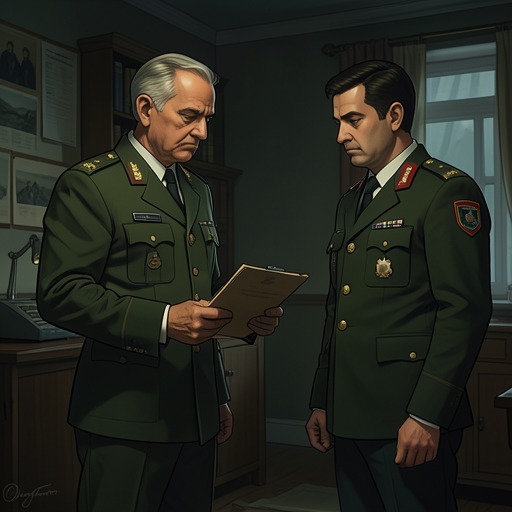
An Officer and a SpyLa Santé Prison is linked to Alfred Dreyfus’s passage from public military degradation into imprisonment through a photograph made at his arrival. The prison itself is not depicted as a scene of extended action; its importance lies in the moment recorded there and in the way that image later becomes part of the case’s documentary and investigative history.
From Degradation to Confinement
The account first establishes the public ceremony that preceded Dreyfus’s arrival. At the École Militaire, four gunners escorted him across the parade ground; after the sentence was announced, General Darras declared that he was no longer worthy to bear arms and degraded him in the name of the French people. Dreyfus then marched around the ground in his torn uniform, repeatedly protesting his innocence as spectators jeered. The procession, timed and watched as a public spectacle, made his condemned status visible to the army and crowd. Alphonse Bertillon later identifies La Santé Prison as the next point in this sequence: he says he photographed Dreyfus when the captain arrived there straight from the degradation ceremony. This places the prison at the transition from a public ritual of disgrace to confinement. The account supplies no further description of the prison’s rooms, regime, or duration of Dreyfus’s stay there, so its significance rests on this sharply defined arrival rather than on an elaborated prison episode.
The Photograph and the Investigative Record
When Georges Picquart sees Dreyfus among Bertillon’s specimens, the prison is recalled through the photograph rather than presented directly. Bertillon says that he took the picture himself on Dreyfus’s arrival. Picquart observes that the photographed man looks different from the one he remembers; Bertillon describes Dreyfus as appearing trance-like, and Picquart reflects that such a state might be a way of enduring the ordeal. The image thus preserves a bodily impression of the ceremony’s aftermath, while the conversation makes clear that it is also an item in a record assembled and interpreted by others. Picquart’s visit is prompted by the Dreyfus case. He explains that he has replaced Jean Sandherr as chief of the Statistical Section, then asks Bertillon to examine photographs of two letters associated with Ferdinand Walsin Esterhazy. The prison photograph and the letters belong to different parts of the inquiry, but their juxtaposition connects Dreyfus’s recorded appearance after degradation with the renewed scrutiny of evidence. La Santé is therefore present not as the site of Picquart’s examination of the letters, but as the place named in the history of the image that first draws his attention.
Public Ritual and Later Reversal
The account’s later return to the École Militaire gives the earlier route through La Santé a stark retrospective contrast. After the Supreme Court of Appeal exonerates Dreyfus, the Chamber of Deputies restores him to the army as a major and awards him the Legion of Honour. Georges Picquart, restored as well, attends Dreyfus’s medal ceremony on the parade ground in the uniform of a brigadier general. The narrative thereby sets the photographed arrival at La Santé, immediately after a ceremony designed to mark disgrace, against a later public ceremony of restored honour. The prison’s brief appearance belongs to that larger contrast: a threshold between condemnation and confinement in a story whose eventual reversal also takes place through formal judgments and military ritual.